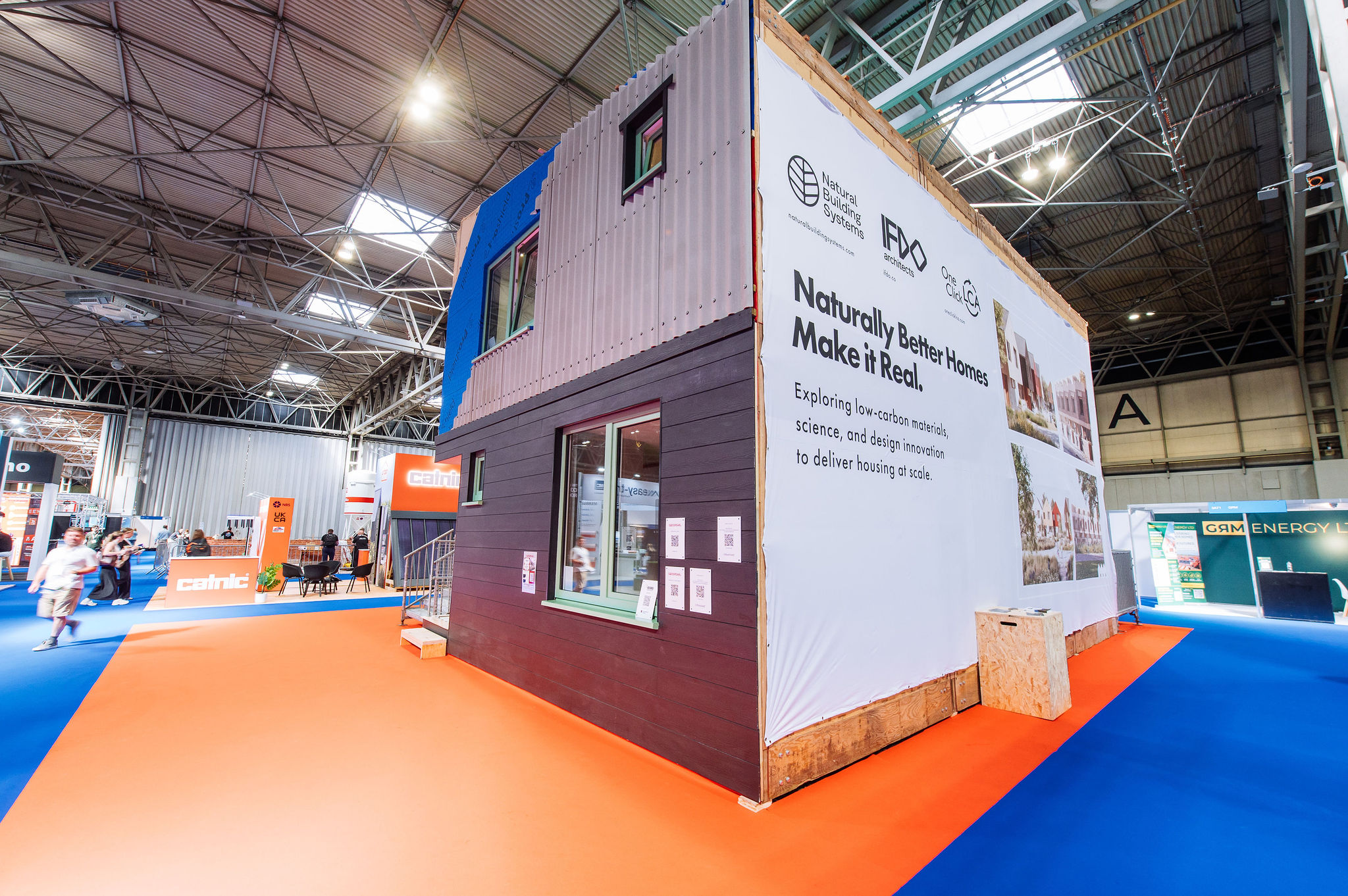
The HAUS at InstallerSHOW will showcase many innovative building products, including Wraptite from A. Proctor Group. We caught up with MD Keira Proctor to find out what this self-adhesive membrane has to offer.
Tell us about one of the products you’re supplying for the HAUS at InstallerSHOW
Our Wraptite product is featuring – it is renowned for use in Passivhaus projects, both domestic and commercial. It’s a self-adhesive, airtight, vapour permeable membrane. The concept of making a membrane self- adhered, so your whole airtightness layer is moved to the external of the building was unique. This means that you can carry out pre-completion testing earlier in the build, i.e. before internal fit out, to ensure that you are hitting your airtightness targets. And, being placed externally, there are fewer issues and risks of penetrations and damage from follow on trades, unlike internal only airtightness lines. It’s a really interesting product and it will be installed on the walls of the HAUS.
Do trades need specialist training to work with Wraptite?
There’s a perception that it might be more complex to install than it actually is – we’re hoping to demonstrate at InstallerSHOW that it’s not complicated and doesn’t need specialist training. I think it will be good for people to see it in action, see it in situ, and understand the benefits of it.
What are the benefits?
One of the major benefits is that you can adhere this to many substrates – and you can actually reposition it. It cures after six hours and then it’s not going anywhere. So if you don’t get it quite right, and especially with the detailing around windows – we do pre-formed corners – there’s a lot of tapes involved and you can peel it back, stick it back on, making sure you get it right for weather resistance and airtightness.
Is it a new product?
It’s been available globally for about 15 years, with the BBA certificate issued 10 years ago in November. At that time, it was a completely new concept, mainly developed for the commercial sector. Passivhaus is at the forefront of sustainable and energy efficient building practices and with Wraptite being a Passive House Institute certified component, we are seeing an increase in Passivhaus projects we are supplying including various schools around Scotland.
And Passivhaus principles are growing in popularity?
Definitely. We are supporting the Scottish government’s development of an equivalent to Passivhaus, for newbuild, and we’re seeing more Passivhaus projects across the country. We were very heavily involved in the UK’s first Passivhaus leisure project – St Sidwell’s Point in Exeter. I think we’re also seeing a lot of people building to Passivhaus principles, they might not necessarily be certified, but people are taking the concepts, applying them and striving towards net zero.
And Wraptite can be used for retrofit and newbuild?
It is mostly newbuild, but it’s used in commercial facades on retrofit projects where airtightness is very important. It can also be utilised internally as it’s moisture neutral, i.e. it allows vapour to move in both directions. It adheres to almost anything, so it can be used in both types of project, however it is excellent for draughtproofing existing buildings making them more energy efficient.
How big a part could Passivhaus play in meeting the government’s ambitious housebuilding targets?
The thing with Passivhaus is that there’s really meticulous planning so people think that’s going to be more complicated, it’s going to take longer, it’s going to be more expensive. But I do find quite a lot of those assumptions to be incorrect. Because there’s so much planning to make sure that it’s built as designed and because it has to achieve these performance characteristics to meet that standard – this removes a lot of the debate around what materials are used, how things are done, so it can speed up the process and the delivery of some of these projects.
The other thing I think has been beneficial with Passivhaus is the integration with local communities, especially with projects like new schools, communicating the benefits and involving them in what’s required in the future for the maintenance of the building, how it works and the importance of design and key performances like airtightness. It illustrates why it’s being done and what they’re trying to achieve.
What do you want InstallerSHOW’s audience to take away from a visit to the HAUS?
That there are options in construction available to achieve better results which is a good thing. I’m hoping that the HAUS can be an educational model for people and highlight that there are different ways to achieve airtightness and easier ways with our products for this type of construction.
Visit the HAUS at InstallerSHOW 24-26 June at the NEC. Register for your FREE ticket here – parking is free too, sponsored by Amazon Business.