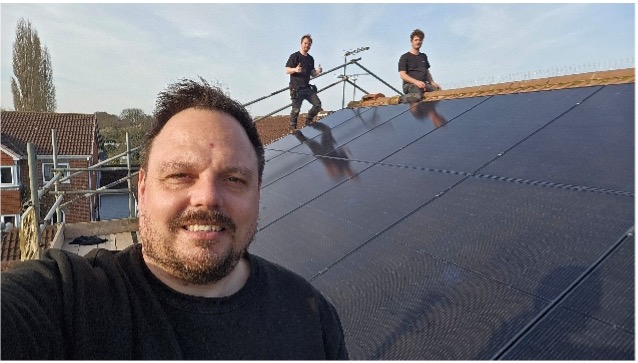
Mark Allison talks about the tools he relies on for installing renewable energy systems.
I thought this month we would delve into the world of tools, one of the best things about working in construction is the range of kit we can now buy to make our jobs easier and safer! In the world of solar/battery, that is ever clearer due to the weight and size of the kit, working at height, termination integrity and loads more.
In the day job of installing solar systems around the UK we have built some key elements into our kit both in terms of safety, making things easier and giving us confidence with the end results. Starting with safety we have to consider ourselves and clients living normal lives around us. So safe processes are critical but sometimes even after the best plans and intentions things can go wrong so tethered tools are absolutely critical. We use those on power and hand tools to ensure nothing falls from the roof to scaffold or worse yet the floor. Drill drivers, band saws, crimpers and grinders are not things you would want to fall on anyone.
Power tools
In terms of making things easier we use a range of M12 and M18 power tools from Milwaukee, featured often on our YouTube channel and content. From basics like the grinders to cut the back of the tiles out or to shape, drivers to send screws into rafters and ratchet drivers to nip up fixings. This is when we move to the more specialist power tools like the M12 digital torque wrench and band saws. The torque wrench ensures our rail fixings and mounting system are to the required specification and band saw cuts said rails to the correct length pre end caps and bird guard. In days of the past this would be the world of spanners, hacksaws and feel for tightness. Not good for the joints, that is for sure.
Hand tools
In terms of hand tools, it is pretty basic with brick trowels, cable croppers, string lines, levels and such. The most important hand tool and arguably tool of all is the MC4 crimper. Many get this wrong and some even use pliers to make those crimps. We have a few kits from SWA, Elkay, stabilu and most recently Knipex. These crimp tools ensure the DC pins on the end of the cable are correctly secured and left weather tight. The plugs will sit out in the elements for decades and ensuring a good connection at the start is so important.
Down at the inverters its normal SDS drills, hammers, drill drivers, ferrule crimpers, VDE drivers and such. Again, minimising wear and tear on the body while ensuring safety and delivering reliable long lasting terminations/installations.
Testing
At the end of the process is the testing, the last step pre operation to prove and record everything is as it should be. My personal favourites are the Test Instrument solutions range with MFT pro plus and PVchecks covering off both the AC and DC testing requirements to hand over systems we know to be safe and performing as designed.
We really are spoilt for choice with so many manufacturers innovating new solutions and improvements each year. The best place to see the results of that are at InstallerSHOW 2025! I will be there for the whole event with the team, and it really is one not to miss.
If you want to see of these tools in action ahead of the show, check out my YouTube channel linked below.
Do not forget to let me know any topics you would like covered in the articles via the below links.
Mark will be speaking at InstallerSHOW 2025, which is 24 to 26 June at the NEC. Register for your FREE ticket here – parking is free, too.








