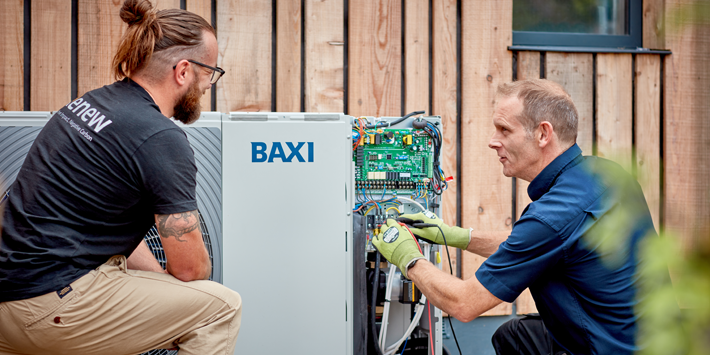
Baxi’s 2026 installer research has revealed a workforce becoming better prepared for low-carbon heating, but that capability is not translating into installations at the pace required. The manufacturer found that installers remain downbeat on demand, although those already fitting heat pumps are more positive.
Six in ten installers are developing heat pump competencies or planning to, while the share ‘actively developing skills’ doubled to 8% compared with 2025’s research, while those ‘definitely planning to’ rose by 10%.
More than 10,650 people completed MCS-aligned training through the Heat Training Grant in its first two years. Yet the survey shows a widening readiness versus opportunity gap: the share already installing air source heat pumps (ASHPs) rose to 5%, but those extremely or somewhat likely to transition declined, while uncertainty and reluctance increased.
Concerns about policy, administration, training and accreditation declined considerably in 2026, including MCS complexity, training costs and government support. Lack of demand remained the leading barrier, with customer concerns about cost and disruption prominent.
The report’s author Will Taylor of analyst Talan noted that the core finding is that the majority of gas installers remains over the age of 45 to 65, while a large proportion of firms are between the size of one to three.
He said: “What we have is a large number of small businesses with an older workforce. The positive spin on this is that the installers say they have an improving pipeline of work continuing in the gas sector. However, while this is good for the engineers themselves, that they have thriving businesses, it creates a challenge for moving towards heat pumps, because a thriving pipeline of existing work is a big barrier to change.”
Ian Trott, Head of UK Training Solutions at Baxi, said this was reflected on the ground at the training centres:
“We see people who have spent a lifetime in the industry who are coming to the end of that working life. And if I’m perfectly honest we’re not doing a brilliant job of backfilling. So we need to do better at that. The other huge challenge is the size of the firms that come through our doors, they are largely one-man bands. Four people is a large firm in this industry. Then you get big jump to the larger contractors. And that’s a real challenge when you’re talking about investment because we’re now saying, why don’t you move into the heat pump world? And actually it’s going to need an investment in training and an investment in infrastructure because now you will have to employ somebody else to do your surveying and probably somebody else to do all the paperwork for MCS. And the real challenge is that all of that investment has no guarantee of work at the end of it. On top of that, if they’ve got a decent pipeline in maintaining boilers, then why bother?”
Among the smaller sample of ASHP installers, 60% of respondents reported increased customer interest or enquiries over the previous year—almost three times the level among other installers. They were more likely to favour greater consumer choice and household incentives to encourage market participation than accreditation or system-design support.
Baxi said that hands-on experience may explain this confidence – helping installers discuss benefits and address myths with customers. Formal training provides technical knowledge, but low installation volumes limit newly qualified installers’ opportunities to gain experience and confidence, it said.
As in 2025, installers preferred heat pumps paired with combi-boilers to heat-pump-only systems. This may reflect lower cost, less disruption and simpler installation, with the boiler supplying hot water instead of a cylinder, Baxi said. Among ASHP installers, greater consumer choice, including hybrids, was the leading measure identified to encourage low-carbon heating participation.
Apprentice views
Baxi partnered with JTL to include apprentices’ views on the industry and sustainable heating technologies in the 2026 survey. Among JTL apprentices, 83% were very or fairly optimistic about their careers. Half saw future opportunities in ASHPs, while 42% selected both hybrid systems and gas boilers. However, two thirds said political debate on net zero and energy policy made the industry’s future direction ‘difficult to understand.’
Clair Bradley, Director of Operations for JTL, said: “It’s encouraging to see that 83% of our apprentices feel positive about their future in the industry. These are the technicians who will deliver the UK’s transition to low-carbon heating, and their confidence matters as much as the technology itself. Our own workforce modelling shows England has lost 25,700 plumbing, heating and ventilation engineers since 2018, with a further 30% fall forecast by 2039 on current trends. That’s a challenge we’re determined to meet head-on. Our apprentices show us there is no shortage of ambition, but what we need now is the investment to open the door to more young people.”
Ian added that the challenge is to get the incentives right.
He said: “We don’t work in an industry where we are forward-planning a long way in advance – three months in advance is good enough. But with heat pumps, we’ve got to work six months in advance. So you are asking people to change their business model – but they have still got all this work, which is paying quite well and has done for 30 to 40 years. So the challenge is incentivising these people to make that change. The work has begun and it is beginning to show some fruition, but investment must continue or it will collapse and everyone will go back to doing what they’ve been doing all the time.”
Ian noted that while there was an increase in training and acknowledging that heat pumps are going to play a part in their future, in the one-off marketplace their customers are not yet saying they want a heat pump.

He said: “Thhat’s a double-edged sword really, because if a homeowner has got one of the 44% of installers who say they don’t see a future in heat pumps coming through their door, they are not going to recommend a heat pump. So as an industry, we have to impress on these installers that a heat pump is part of their future and give them the right tools to be able to talk to their customers correctly.
One of the recommendations in the report is about how we can think about supporting installers, not just to be technically expert, but also to see them as pivotal access points within the market for consumers – they are salespeople, or market makers, no longer just people who go into a property and install a product.”
Baxi said its findings highlight the need to connect installer capability with consistent consumer demand.
It said: “Priorities include long-term certainty for the Boiler Upgrade Scheme, lower relative electricity costs, timely and trusted Warm Homes Agency advice, and support to integrate heat-pump sales and delivery into installers’ everyday operations.”
Find out more at: https://www.baxi.co.uk/
Continue reading — it's free
Register for free to unlock exclusive Installer content.








