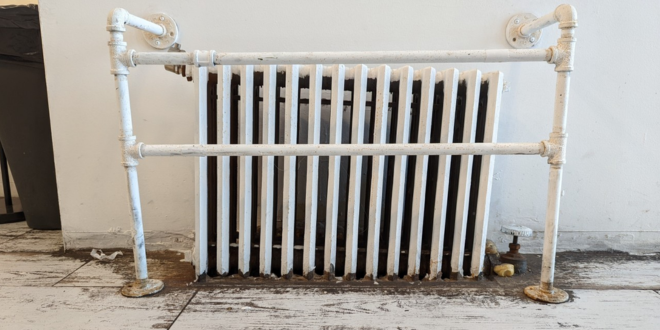
Nick Baylis – CEO at Castrads – looks at the worrying trend of falsified radiator outputs, and puts forward the case for Km and n:
As we move to low-temperature heating, falsified radiator outputs are moving from a minor annoyance to a major design fault that the homeowner pays for in increased running cost, the radiator industry through loss of reputation and the public purse through VAT exemptions on low carbon systems.
A radiator’s heat output depends on the temperature of the water inside it, and those temperatures have been falling for 150 years in the name of efficiency. Steam heat (~100ºC) gave way to hot water boilers fired by coal and oil (~80ºC), then to gas, first non-condensing (~70ºC), then condensing (~60ºC). When the water (or better still, the steam) is hot, nobody notices if the output’s a little off. When the fuel’s cheap, nobody cares if they have to turn the boiler up.
Heat pumps remove the slack entirely.
When expert heat pump engineers like Iain Johnston , Michael Walsh MCIPHE RP , Damon Blakemore and Fred Rickman come to us at Castrads they’re often designing for mean water temperature barely above body temperature. These master engineers are designing for precision and efficiency and they’re reliant on the data that us manufacturers provide. With improvements in heat loss calculations, radiator sizing has become a finely-tuned science. If the radiator output doesn’t satisfy the room’s heat loss then the heat pump has to push up its flow temperature to compensate and the efficiency of the system suffers. With the spark gap at roughly 4.7, the homeowner then pays for that compromise every single day the system runs and heat pumps get a bad rep.
This is why two dirty little secrets in the radiator industry suddenly matter far more than they used to, and why my colleagues and I at MARC – Radiators & Convectors have been working with the mighty Office for Product Safety and Standards for the last year.
The first dirty secret is the outright false output: a wattage figure that no Notified Body has ever verified. The second is quieter and far more common: quoting outputs at ∆T60 instead of the standard ∆T50, confusing the customer and contravening the standard. A bigger temperature difference gives you a bigger number, so a radiator advertised at ∆T60 looks more capable than one honestly declared at ∆T50, by around 20%, when it’s nothing of the sort. To a homeowner comparing two products side by side, the inflated one just looks better. Rob Nezard highlighted this issue brilliant in his excellent exposé a couple of years ago:
In a hot gas system, that practice of overstating usually had few consequences because systems were often oversized anyway. In a heat pump system there’s no headroom to forgive it. An inflated output means an undersized radiator. An undersized radiator means a heat pump working harder and hotter than it should. And that means a system that costs more to run every day for the rest of its life.
So the homeowner pays twice. Once through the design itself, a system built on a number that was never real, running harder and colder than it ought to. And again, very possibly, through the public purse: low-carbon heating qualifies for zero-rated VAT including the radiators. Design a system around a falsified output and we’re all chipping in to fund something that was never going to perform.
There’s a subtler problem too. Most of the heat-loss software we now design with (including packages that we use in house) takes a rated ∆T50 output and corrects it to the design temperature with a single generic correction formula: Φ₅₀ × (∆T/50)^1.25. That 1.25 is an industry average, not the figure on any one test certificate, and the gap between it and a product’s true value gets wider as the temperature drops. So even a properly declared radiator can end up sized on an approximation. The differences are small, granted. But every time the manufacturer’s figure and the software’s figure don’t quite agree, it looks a bit off.
There is a better way to say what a radiator actually does, and I think we should all start using it.
Under BS EN 442-1, every radiator has to be tested by a Notified Body and its output written up as a characteristic curve: Φ = Km × ∆T^n, where Km and n are constants particular to that product and independent of water temperature. They describe how the radiator behaves at every temperature at once. For our cast iron radiators, tested mostly by the brilliant Tomas Webster (and before him the legendary Phil Stonard ) at BSRIA , n comes out somewhere between 1.2 and 1.35, which is just how cast iron gives up its heat.
Accuracy is only half of why I like them. The other half is that they’re hard to hide behind.
A single output figure can be quoted at a “flattering” water temperature, or simply made up. Km and n are harder to game. They’re less well understood, for one thing, and I think far less likely to be cherry-picked. They don’t depend on temperature, and they trace straight back to a Notified Body certificate. Ask a manufacturer for its Km and n, the Declaration of Performance they sit in, and the test certificate behind that, and an inflated output has nowhere to go.
Which brings me to the call to arms, aimed at the people who are shaping low-temperature design in this country: not only the radiator manufacturers of the world, but also the likes of Heat Geek , Spruce , h2x and Heat Engineer Software .
Let’s all start using Km and n in our software rather than correction factors! The numbers we need are on the Declarations of Performance. It’s more accurate and we’ll all get to the same number if we all use the same formula.
Once the industry expects these figures as a matter of course, the inflated output and the unverified wattage get a lot easier to spot. The honest manufacturer loses nothing, because its numbers were always real. The bad actor has nowhere left to put the exaggeration.
It’s a tiny change, and most homeowners will never know it happened. But it would mean every heat pump system in the country is sized on what a radiator genuinely does.
Continue reading — it's free
Register for free to unlock exclusive Installer content.