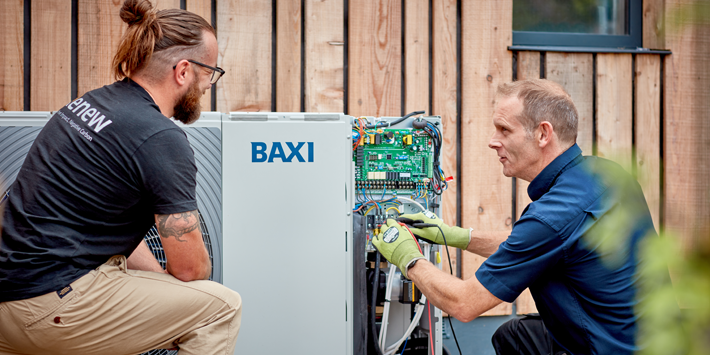
Transitioning from a traditional gas engineer into heat pumps isn’t easy or straightforward – but moving into renewable technology can be highly lucrative and rewarding.
To mark National Heat Pump Week, Mark Shaw – a Tutor at Smart Energy Training – made the switch himself so understands both the hurdles which need to be cleared and the opportunities available to engineers who are prepared to invest in their development through training:
Here, Mark looks at some of the challenges facing engineers when moving into heat pumps – and why the industry represents an exciting prospect for those ready to take the next step.
Proving competency to access grants
In my experience, a lot of one-man bands think it’s too hard to get into heat pumps. While it’s important to be realistic about the challenges ahead, it is certainly not an insurmountable target.
Most people will want to access the Boiler Upgrade Scheme grant to help generate more leads as it gives consumers up to £9,000 towards their installation.
To access this market, however, engineers need to make sure they have the appropriate certification and business processes in place.
Most notably, engineers will need to apply to a Competent Persons Scheme, pass its assessment and then add the MCS certification. For a lot of sole traders, that can feel like a significant barrier, not because they are not capable, but because their admin and management systems aren’t always the best.
For example, engineers must provide evidence of how the business manages work, including areas such as quoting, risk assessments and compliance documentation.
They must also make a suitable installation available for an assessor to inspect, pay the application fees and keep records of ongoing compliance.
It’s important to remember that this is not just about being able to install a heat pump correctly. Engineers also need to demonstrate that they have the processes in place to deliver good installations consistently and safely.
The important thing is to see this as part of becoming a professional heat pump installer, rather than simply another qualification to achieve. The right preparation can make the process much more manageable.
Maintaining standards and building confidence
Achieving certification is an important milestone, but maintaining it is part of the ongoing commitment to working in the sector.
MCS was recently redeveloped to encourage installers to work to a higher standard. An annual review is required as well as ongoing site assessments, and people must provide evidence of business records. That doesn’t happen as often with the Gas Safe Register.
For a small business, where the engineer may also be responsible for sales, installations, customer service and accounts, this can represent an additional workload. However, having these systems in place can also help businesses operate more efficiently, deliver a better customer experience and build trust.
Anything that is Government funded comes with specific requirements. Good organisation can help installers manage projects effectively and avoid unnecessary delays to payments and cashflow.
There is also the question of keeping up with the requirements once you are certified. Engineers need to make sure their documentation remains up to date, that any issues identified during assessments are addressed and that they continue to meet the relevant standards.
System design is key for a good heat pump installation and installers need to go back to proper engineering practices rather than working to rules of thumb like many have done with boilers for the past 30 years.
For experienced gas engineers, this is an opportunity to develop their knowledge further and apply their existing understanding of heating systems in a new way.
Alternative options
It’s important to note that engineers do not necessarily have to establish their own fully-accredited business from day one.
What many people will do, initially at least, is to work for an umbrella company which already holds MCS accreditation. Many of these companies are looking for subcontractors, and this represents a good opportunity for people to convert from gas to heat pumps.
The MCS accredited company might charge a fee for you to operate under their certification, or you could agree to work for a fixed price.
Some engineers start like this and then eventually get their own MCS, while others find it easier to always work for a large organisation that can handle the administrative side.
It can be a sensible way to gain practical experience, understand the customer journey and see how heat pump projects are managed before taking on the full responsibility yourself.
It also means engineers can start building a reputation in the sector without necessarily having to invest in every part of the business infrastructure straight away.
The opportunities
Heat pumps are only going to get more popular as we transition to this technology. There is a lot of work out there already and it can be very lucrative. I’m not sure everyone realises that yet.
Installers still have the chance to get ahead of the game by moving over to heat pumps. It can also open up new avenues in the future, such as F-Gas, which is another growth area.
The length of time it takes to get heat pump qualified varies. For some it could be as little as two months, for others it could longer.
Installers will need to be assessed on their first job, though that can happen via a video call sometimes, and then they are free to work once they have been approved.
The key thing is not to be put off by the process. It is a different way of working, but the skills that traditional gas engineers already have are valuable. Understanding heating systems, working with customers and diagnosing problems are all transferable skills.
The industry needs experienced engineers, and those who are prepared to invest in their training and put the right systems in place can build a very good business. The opportunity is there, but it is important to go into it with your eyes open.
At Smart Energy Training, we offer a number of courses to help gas engineers transition to heat pumps. Crucially, we not only ensure our learners understand the practical aspects of installations, but also all of the administrative skills needed to succeed.
Find out more at: https://www.smartenergytraining.co.uk/
Continue reading — it's free
Register for free to unlock exclusive Installer content.