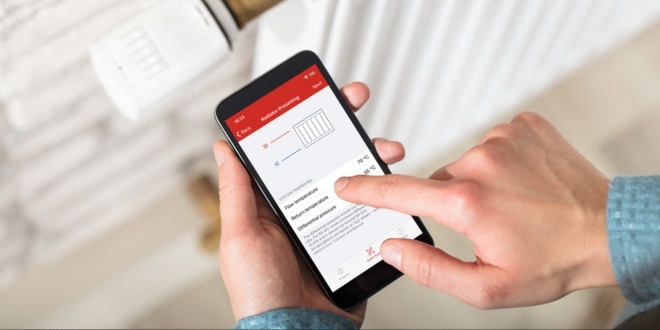
Gareth Ash, Danfoss UK, looks at why selecting the right heat pump controls should start with the system itself, and why heating professionals need to consider comfort, usability and application from the outset.
When it comes to heat pump controls, everyone seems to have an opinion.
Spend a few minutes scrolling through social media or chatting with others in the trade and you’ll hear plenty of debate around weather compensation, smart thermostats, zoning, room controls and system optimisation. Often, those conversations end with someone claiming they’ve found the “best” solution.
The reality is a little different.
After speaking to heating professionals across the UK, it’s clear that the most successful heat pump installations don’t begin with a fixed control strategy. They begin with a clear understanding of the property, the heat emitters and how the customer expects their heating to work. The right controls for one home may be completely unsuitable for another.
Before recommending any approach, it’s worth spending time understanding how the customer actually uses their heating day to day. Their lifestyle, routines and comfort expectations should shape the solution just as much as the technical design.
There is no universal answer and, in many ways, that’s what makes heat pump design both challenging and interesting.
Start with the Emitters
One of the first questions heating professionals should ask is a simple one: what exactly is the heat pump heating?
A radiator system behaves very differently to underfloor heating. Radiators tend to respond relatively quickly to changes in temperature, while underfloor heating operates more gradually due to the thermal mass of the floor construction.
Many properties now feature a combination of both. A common scenario is underfloor heating downstairs with radiators upstairs, particularly in extensions and renovation projects.
These mixed-emitter systems can work exceptionally well with heat pumps, but only when the controls reflect how the different parts of the system behave.
Trying to control everything in exactly the same way can lead to compromises in comfort, responsiveness or performance. Getting this right early on gives the control strategy a much better chance of supporting how the system is meant to work in real life.
Homeowners Buy Comfort, Not Controls
As an industry, we often focus on efficiency figures, flow temperatures and system performance. While these are all important, homeowners tend to judge their heating system using a much simpler measure.
Do they feel comfortable?
If rooms are reaching the desired temperature, the home feels comfortable throughout the day and the system is easy to live with, most customers will consider the installation a success.
On the other hand, if rooms overheat, temperatures fluctuate or the heating feels unpredictable, those issues will quickly overshadow any discussion about efficiency gains.
That’s why controls should never be viewed purely as a technical component. They are a key part of the customer experience. The right control strategy helps create the stable, consistent comfort homeowners expect, while allowing the heat pump to run efficiently without the customer needing to think about it.
Simplicity Often Wins
As controls technology continues to evolve, heating professionals have access to more features and functionality than ever before.
However, more technology doesn’t automatically mean a better outcome.
In many cases, the most successful installations are those where the controls are intuitive and easy for homeowners to understand. Customers shouldn’t need an instruction manual every time they want to adjust their heating.
Good controls should make life easier, not more complicated.
That means turning the earlier conversation with the customer into a setup that feels simple, practical and easy to live with. If the homeowner understands the controls and feels confident using them, the installation is far more likely to deliver the comfort and efficiency it was designed for.
Don’t Leave Controls Until the End
One of the most common challenges on heating projects is treating controls as an afterthought.
By the time controls are being specified, decisions have often already been made about emitters, zoning, pipework and system layout. The controls are then expected to solve issues that could have been addressed much earlier in the design process.
The best projects take a different approach.
Controls should be considered alongside the overall system design from the outset. That means thinking about how different areas of the property will be used, how occupants want to manage comfort and how the emitters will respond to changing demand.
Taking this joined-up approach makes it far easier to avoid compromises later and create a system that works efficiently, feels comfortable and is straightforward for the customer to use.
There Is No Silver Bullet
Perhaps the most important lesson from the growing number of heat pump installations across the UK is that there is no single control strategy that works for every property.
Some homes will benefit from room-by-room temperature control. Others may perform best with a simpler, more centralised approach. Some customers will value advanced smart functionality, while others simply want dependable heating that quietly does its job.
The key is understanding the application.
As heat pumps become more common, heating professionals have an increasingly important role in helping homeowners make sense of the options. Selecting the right controls is a crucial part of delivering an installation that performs as intended and keeps customers satisfied long after commissioning.
So, the next time a debate starts about the “best” heat pump controls, it may be worth asking a different question.
Not what’s best in theory, but what’s best for the system in front of you.
Danfoss offers a wide range of heating control solutions, from room controls and smart heating options to zone control and underfloor heating. Our knowledgeable team is always available to discuss solutions and help heating professionals find the right approach for each project.
Because when it comes to heat pumps, the right choice depends on the system.