In the next in our series on domestic water solutions, Chris Lightfoot, National Sales Manager at Stuart Turner provides an overview of water conditioners and how they help overcome the issues experienced by customers living in hard water areas.
Limescale build up, the most common symptom of hard water, is a problem that is faced by millions of households in the UK. Hard water is the result of water absorbing calcium as it filters through the ground. Statistics from British Water suggest that as much as 60% of the UK is supplied with hard water, including large parts of southern, central and eastern England.
Hard water is water that contains over 200mg of calcium carbonate per litre (also described in parts per million or ppm), and will cause the formation of limescale within water systems and household appliances, including washing machines, dishwashers, kettles and showers. This affects the performance of the appliance and can ultimately shorten its lifespan.
Limescale also forms on surfaces within the boiler and heating system, reducing the efficiency and increasing energy costs. As such, the Compliance Guide that accompanies Part L of the Building Regulations states that where mains water hardness exceeds 200 ppm the feed to water heaters and combination boilers should be treated to reduce the rate of limescale build-up.
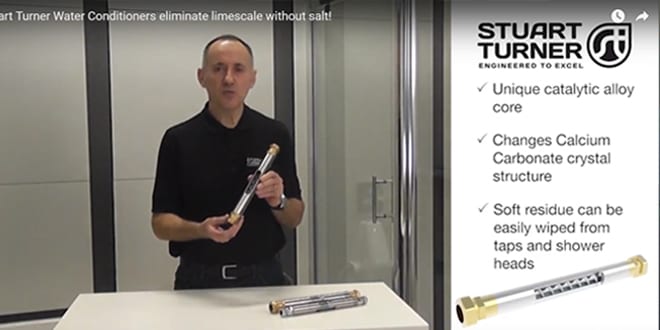
There are a number of solutions for addressing hard water, however one of the most cost-effective options is to install an inline water conditioner on the mains supply to the property. A catalytic water conditioner, such as those from Stuart Turner’s Stuart range, features an alloy core that treats the water as it passes over it by altering the chemical structure of the calcium carbonate. It converts the calcite, which forms a hard scale, into the softer aragonite that does not build up in pipes or appliances. This process does not affect the quality of the water and as such it can be used straight from the tap and is safe to drink.
Furthermore, for customers this is often the simplest option as unlike, water softeners where the salt must be replenished regularly, a catalytic water conditioner is a fit and forget solution. It requires no maintenance, has no ongoing running costs and high-quality conditioners will typically last for 15 years or more before being replaced.
In addition, when installed on the cold water mains into the property, the conditioner will provide a whole house solution to protect all appliances and water outlets within the property from limescale build up. As such it will work alongside measures designed to protect the boiler, such as chemical water treatment and filters. Customers will also benefit from the additional advantages of conditioned water such as easier cleaning of bathrooms and kitchens.
There are water conditioner products suitable for a wide range of different applications. Where a single appliance solution is needed there are smaller versions that can be fitted directly before the outlet or appliance to provide specific protection, such as in line with a shower. For larger properties, including commercial and industrial applications, higher capacity conditioners that combine the catalytic and magnetic action are available. For example, Stuart Turner’s catalytic-magnetic (CM) products are suitable for applications where a flowrate of up to 1260 litres per minute is required.
Hard water and the limescale build-up presents a serious issue for customers, and in hard water areas Part L compliance depends on reducing its effects. Inline water conditioners offer a simple, long term, low maintenance solution for whole property protection.
To find out more about Stuart Turner’s range of solutions visit www.stuart-turner.co.uk.