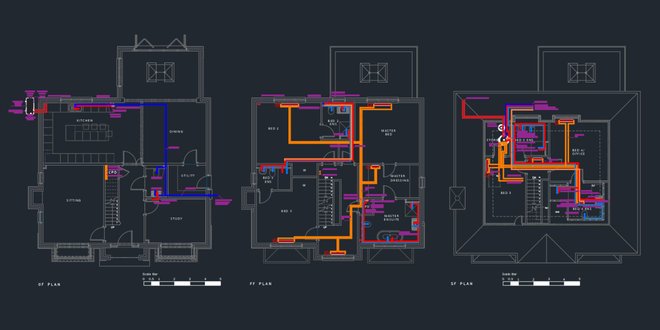
As part of this year’s National Heat Pump Week, Neil Hope, Business Development & Technical Management for Renewables at City Plumbing, looks at the top considerations that impact heat pump performance in new homes.
As low carbon heating becomes a more established part of new build housing, and especially as the Future Homes Standard comes into play, the way heating systems need to be designed, specified and installed is changing.
Whether you’re a builder working on a single plot, a small number of homes, or a heating engineer fitting a system in a single new build property, heat pumps need a more joined up approach than traditional boiler systems. Building fabric, heat demand, emitters, controls, hot water and ventilation can all influence how the system performs, which means decisions made at different stages of a project are increasingly interconnected.
Getting the right information and making the right decisions early can help create systems that are simpler to install, perform as intended and meet the needs of the people who will live in the home.
1. Start with the building fabric
Good heat pump design always begins with understanding the property itself – and that’s true if you’re working on a new build or a retrofit.
A building’s fabric and ventilation system determine its heat loss and, ultimately, the energy required to maintain a comfortable internal temperature. This means accurate fabric U-values and air changes from infiltration and ventilation are needed for a proper heat loss calculation, which forms the foundation for the rest of the system design.
In new build homes, heat demand can be relatively low – a modern property, for example, may have an average heat loss of around 3kW to 4kW. As such, rather than starting with a preferred heat pump and designing around it, installers need to establish what the property requires first. That information can then inform decisions around capacity, emitters, controls and pipework.
While a relatively simple principle, it’s one that’s increasingly important as homes become more thermally efficient.
2. Bring ventilation into the design
Alongside heating, ventilation also needs to be part of the design, particularly as new homes become more airtight and Approved Document F requirements, which sit alongside the Future Homes Standard, reinforce the need to consider ventilation, heating and building fabric as part of one joined-up approach.
Many new homes still use decentralised mechanical extract ventilation, such as extractor fans in bathrooms and ensuites, but mechanical ventilation with heat recovery (MVHR) systems are becoming more common.
Ventilation has a bearing on the heat demand of the property, so it needs to be understood at an early stage. Considering ventilation alongside fabric performance provides a more accurate picture of how the property will behave in use and helps ensure the heating system is designed around the building as a whole.
To help remove some of the guesswork involved in assessing a property’s ventilation heat loss, CIBSE has recently released an update on how ventilation heat loss can be calculated more accurately using air permeability, which is a great resource for installers.
3. Consider emitters and controls together
Once you understand the heat demand, you need to work out how that heat will be delivered.
Whether a property uses radiators, underfloor heating or a combination of the two will influence the way the system operates. At the same time, the control strategy also needs to be considered.
Heat loss calculations are often based on a steady-state condition, where the heating system maintains a set internal temperature against a specified outdoor temperature. In practice, many homeowners use their heating differently. Many people will turn it off overnight, then want to bring the temperature back up in the morning. Using a system in that way changes the demand and, in turn, the design.
If a system is designed to maintain a relatively stable temperature but is then operated with large setbacks and rapid recovery periods, its performance may not reflect the original design assumptions.
The type of control also matters, as some system controls are designed with a simple on-and-off mechanism. Where the manufacturer’s controls allow optimisation and sensible temperature setbacks, they can support more efficient operation, but where they don’t, compatible “smart” third-party controls are a good option. These controls are sympathetic to heat pump operation and are able to optimise the heat pump’s performance using features such as flow temperature control, automatic weather compensation, tariff flexibility where appropriate and learning capabilities.
The key is to consider how the system is likely to be used, and make sure the heat source, emitters and controls are all designed to work together rather than treated as separate elements.
4. Account for hot water demand
One of the biggest design considerations in new build homes is the balance between space heating and domestic hot water demand.
As properties become more thermally efficient, the amount of energy required for space heating falls. Hot water demand, however, does not reduce at the same rate.
A modern four-bedroom home with three ensuite bathrooms could have a space heating requirement of around 4kW while still needing approximately 250 litres of stored hot water. That can make selecting the right size heat pump a bit of a challenge.
A unit sized purely against the space heating load may provide relatively slow hot water heating. Increasing the heat pump capacity can improve that time but may also mean the unit is oversized for space heating, which is a problem with milder weather.
If a property’s peak heat demand is 4kW, the requirement on a mild spring or autumn day may be closer to half of that. A heat pump selected to provide the necessary hot water demand therefore needs to be capable of operating effectively at much lower outputs.
This is where minimum modulation – the lowest output a heat pump can maintain while still running – is key. In highly efficient new homes, where heating demand can be very low for much of the year, the ability to reduce output sufficiently can help avoid repeated cycling and support more efficient operation.
If the heat pump cannot reduce its output enough, it may reach the required temperature, switch off and then restart again soon afterwards. Over time, this cycling can affect efficiency and longevity.
For energy efficient new build homes, installers need to consider both ends of the operating range. Although maximum output is a big factor, so too is the heat pump’s ability to operate effectively when demand is low.
5. Design the system around the heat pump
Selecting the correct heat pump does not guarantee a well-performing system – its surrounding infrastructure must also support how it operates.
Pipe sizing is a great example of this. A property may have a relatively low space heating demand, but the primary pipework still needs to be capable of transferring the heat pump’s full output when required, for example, where domestic hot water production demand exceeds the space heating demand. If pipework is sized only to that lower heating demand, it can limit how much heat the system can move.
The system may also suffer from noise and erosion and, in particularly bad cases, hinder heat pump operation due to low flow rates. This is also particularly important in retrofit projects where sections of primary pipework may be hard to access or upgrade.
System water volume is another area to consider. Having sufficient volume can help reduce cycling and support more stable operation, which may mean adding a volumiser or buffer vessel in some installations. However, these components should not automatically be treated as a standard add-on to every heat pump system.
Each installation should be considered on its specific requirements, thinking about the existing system volume, manufacturer guidance, and operating conditions. This helps avoid unnecessary complexity and cost and ensures every component has a role in the system.
Don’t work in isolation
Ultimately, heat pump design cannot be considered in isolation. The fabric, ventilation strategy, heat demand, emitters, controls, hot water, and pipework all influence how the finished system performs.
That is why having access to the right support can make such a difference, particularly as more installers and builders take on low carbon heating projects.
City Plumbing supports projects from individual properties to large housing schemes, offering technical guidance, heat pump design and selection, and product advice across a wide range of low-carbon technologies, all supported by an in-house technical design team and regional renewables sales managers.
For larger developments, we can also provide a fully indemnified design service covering multiple technologies, helping bring the different elements of the system together within a coordinated design.
The key is to bring the right expertise in early and make decisions with the whole system in mind. That helps reduce the risk of problems later, gives installers and builders greater confidence in the specification and delivers a better performing home for the customer.
For support, customers can speak to their local City Plumbing branch or contact the renewables team directly on [email protected].
Find out more: City Plumbing | Plumbers Merchants & Plumbing Supplies
Continue reading — it's free
Register for free to unlock exclusive Installer content.