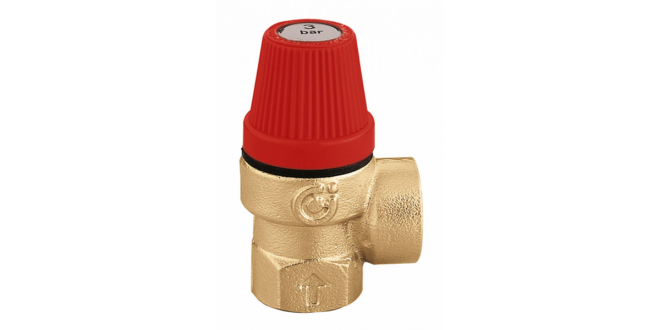
Safety relief valves (SRVs) are an essential safety component used across sealed heating systems, stored hot water cylinders, solar heating systems and water distribution systems. Their role is to relieve excess pressure, opening when the system reaches the valve’s set pressure to help protect the system and its components.
But when an SRV starts to discharge, is the valve itself actually the problem, or is it highlighting an issue elsewhere? Understanding why an SRV operates, and what to check when it does, can help installers identify the underlying cause before simply replacing the valve. Ed Morris – Technical Manager, Altecnic – explains:
How Does a Safety Relief Valve Work?
Under normal operating conditions, the safety relief valve remains closed. If system pressure rises to the valve’s calibrated set pressure, the valve opens and discharges excess water through an outlet pipe and tundish to a suitable drain.
By relieving this excess pressure, the SRV prevents the system from reaching potentially dangerous pressure levels, helping to protect the boiler, hot water storage cylinder and other system components.
Want to know more? Read our Safety Relief Valves In Focus guide.
Why Is My Safety Relief Valve Discharging?
If an SRV is discharging, it doesn’t necessarily mean the valve itself is faulty. It may simply be doing its job because the system has reached the valve’s set pressure.
One of the most common causes is an issue with the expansion vessel. If the vessel is incorrectly sized, has the wrong pre-charge pressure or has failed, there may not be enough capacity to accommodate expansion as the system heats up, causing pressure to rise and activate the SRV.
Unsure whether the expansion vessel is correctly sized? Use Altecnic’s Expansion Vessel Sizing Calculator to calculate the required vessel size for the system.
If system pressure is correct but the valve continues to pass water, it may not have reseated properly after operating. This can happen if system debris becomes trapped beneath the valve seat, if pressure has not reduced sufficiently for the valve to close, or if the system continues to operate very close to the valve’s set pressure.
Before replacing an SRV, installers should therefore establish why it has operated and check the wider system for the underlying cause.
Getting Installation Right
Correct positioning and discharge arrangements are essential to ensure an SRV can operate safely. In a sealed heating circuit, the valve should, where possible, be installed on the flow circuit close to the heat source and no more than one metre from the boiler.
For a water heater, the SRV should be installed on the cold-water supply, with no restrictions in place between the water heater and the valve.
The discharge arrangement is equally important. To comply with Water Regulations, the valve should not discharge directly to a drain. Instead, water should pass through a visible tundish with an AUK3 air gap, positioned adjacent to the SRV, before being safely discharged.
The discharge pipe should be the same size as the valve outlet, no longer than two metres, and contain no more than two elbows.

When Does an SRV Need Attention?
An SRV should be checked if installers notice warning signs such as:
- Repeated or continuous discharge
- The valve failing to reseat after operating
- System pressure regularly approaching the valve’s set pressure
- Visible leakage, corrosion or debris around the valve
- Issues with the discharge pipework or route
If an SRV has operated, the cause should always be investigated before simply replacing the valve. If an underlying pressure or expansion issue remains unresolved, the replacement valve could soon experience the same problem.
Want to see it in practice? Watch Altecnic’s Safety Relief Valve video for practical guidance on how SRVs work, common issues and what installers should check: https://www.youtube.com/watch?v=uWg_lySYjU8&t=1s
A Small Valve with a Critical Role
Safety relief valves provide an essential safeguard against excessive pressure, but correct installation and an understanding of why they operate are just as important. By looking at the wider system when problems arise, installers can identify the root cause and help ensure the system continues to operate safely.
For further product information and technical specifications, explore Altecnic’s Safety Relief Valve Range.
Continue reading — it's free
Register for free to unlock exclusive Installer content.








