Modern access control technology goes beyond simply regulating the entry and exit of a building. InstallerELECTRIC explains how it can now integrate multiple building services into a single platform, while also collecting data that delivers valuable operational insights.
The past few years have brought about significant changes and challenges in the workplace, forcing organisations to re-evaluate their approach to building services infrastructure. In this era of rapid technological advancements, access control technology has emerged as a key player in the development of intelligent, connected and secure buildings. What was once merely a tool for locking and unlocking doors has become a cornerstone of integrated building systems, connecting people, spaces and data in real-time.
Defining moment
According to the Chartered Institution of Building Services Engineers (CIBSE), smart building technology can ‘help building owners, property managers and occupants realise their goals in the areas of costs, lifetime energy management, wellbeing, convenience, safety, long-term flexibility and marketability, to achieve buildings which have high social, environmental and economic values’. Using this definition, it is clear that an increasing amount of a building’s true value now resides in the intelligence integrated into its infrastructure.
Access control technology is helping to create smarter buildings in line with CIBSE’s vision by integrating seamlessly with a wide range of building services. These include CCTV, energy management, audiovisual (AV), lighting, lift systems, digital signage, public address, water management, heating, ventilation and air conditioning (HVAC), as well as fire detection and life safety systems.
This is increasingly important – for example, in the event of a fire, lockdown or other emergency, integrated systems can assist first responders by providing real-time data on occupant location, unlocking doors for evacuation and guiding people to safety with automated lighting and signage.
Convenience is another key driver of the modern access control revolution. Gone are the days of lost keys and cumbersome access logs. Today’s systems offer mobile credentials, facial recognition and remote access provisioning that streamline the user experience. Tenants, employees and visitors enjoy frictionless access, while administrators benefit from centralised control and real-time monitoring.
Energy flash
Energy efficiency is increasingly essential for all buildings, as many organisations are now operating under hybrid working models. Keeping a building open with fewer occupants increases operational cost but an access control system can provide information to manage resources in a way that reflects the actual, rather than imagined, use of a building.
Developing a comprehensive knowledge of a building and how it is used makes it possible to enhance operational effectiveness and increase employee productivity. By knowing who is in the building and where they are, energy use can be tightly regulated. For example, a conference room that remains unoccupied despite being reserved can trigger automated lighting and climate control systems to power down, saving significant energy over time. Similarly, access data can help facilities teams better understand building usage trends, allowing them to fine-tune resource allocation and maintenance schedules.
Response mechanism
An interconnected infrastructure approach allows buildings to respond intelligently to the needs of their occupants, enhancing both efficiency and the user experience. A good example of this is when an employee swipes their access card to enter a room. An integrated system can automatically adjust the lighting and temperature to align with their individual preferences, enhancing comfort. Additionally, integrated access systems can reduce congestion at entry points and increase privacy and control for occupants.
From biometric authentication to cloud based credential management, modern access control solutions are redefining how buildings operate. For electrical contractors, this means new opportunities and challenges. The traditional role of wiring and installing basic security hardware is expanding into sophisticated IT infrastructure integration. Contractors that understand IT networking, cloud platforms and cybersecurity are finding themselves in high demand, as they are able to deliver comprehensive smart building packages that meet the evolving needs of property owners, occupants and facility managers.
Sensory perception
The internet of things (IoT) has enabled seamless connectivity for building services, with sensors playing a crucial role in gathering and transmitting data to access control systems. These sensors track various parameters such as temperature, humidity, indoor air quality, power consumption by zone, occupancy levels and space utilisation. Additionally, cloud based technology is transforming access control systems by providing fully customisable dashboards that can be accessed from any internet connected desktop or smartphone, enhancing convenience and control.
Integrated cloud based access control solutions not only simplify the deployment of IoT networks, but also bring optimal connectivity between devices. By accessing, storing and processing data from smart IoT sensors it is possible for an access control system to deliver valuable business intelligence, operational insights and efficiencies via a single pane of glass.
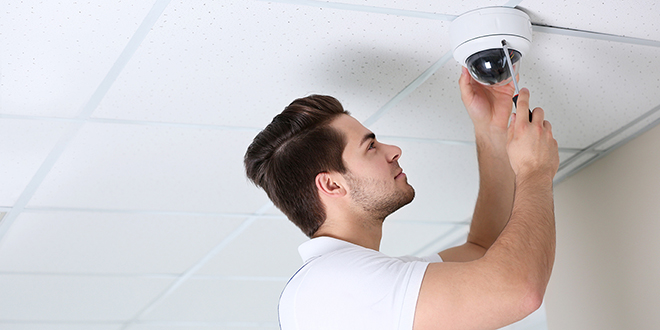
Correlating access events with corresponding video footage significantly enhances overall building security by enabling more effective incident investigations and the identification of unauthorised access or suspicious behaviour. In the event of a security breach, integrating data from access control and video surveillance systems allows for a detailed reconstruction of the incident timeline. This can help identify the individuals involved, understand their actions and assist with the implementation of appropriate actions to prevent similar incidents in the future.
Smart thinking
As the demands on buildings continue to evolve, access control is rapidly becoming a linchpin of smart building infrastructure. Electrical contractors who embrace it are not just installers of this technology, they are system integrators, consultants and enablers of the modern built environment. With the right skills and forward thinking mindset, they are well positioned to lead the charge in making buildings more secure, energy efficient and responsive than ever before.